Currency
The term “Three Months” frequently mentioned in the Islamic world refers to a period where worship, charity, and good deeds are abundantly performed. the Holy Three Months in question are the 7th, 8th, and 9th months of the Hijri calendar: Rajab al-Murajjab, Sha’ban al-Muazzam, and Ramadan al-Mubarak. Following Ramadan al-Mubarak, Muslims also observe the months known as the pilgrimage months: Shawwal, Dhu al-Qi’dah, and Dhu al-Hijjah, making a six-month period of striving for Allah’s pleasure, both materially and spiritually. This is why the Holy Three Months are seen as an opportunity to draw closer to Allah and are considered a period that spiritually influences the rest of the year.
Dua to be Recited in the Holy Three Months:
“Allâhümme bârik lenâ Recebe ve Şa‘bân ve belliğnâ Ramazân.”
“O Allah, bless us in Rajab and Sha’ban and allow us to reach Ramadan.”
Hadith al-Shareef
The first of the Holy Three Months, Rajab al-Murajjab, will commence on January 1, 2025. It will be followed by Sha’ban al-Muazzam and Ramadan al-Mubarak, completing the three-month cycle. These months are highly recommended and full of glad tidings as emphasized by the Prophet (sav).
the Holy Three Months are a period mentioned frequently in Hadith al-Shareefs and Quranic verses, containing four holy nights. The saying “The honor of a place is determined by what it contains.” also applies to time. The value of time is elevated by the significant events that occur within it. For example, the 12th night of the month of Rabi’ al-Awwal, known as Mawlid Night, is made precious by the birth of the Prophet (sav). Similarly, the Holy Three Months are deemed valuable both for the significant events they host and for the glad tidings mentioned in the Quran and Hadith al-Shareefs. In a well-known Hadith al-Shareef, it is stated:
“Rajab is Allah’s month, Sha’ban is my month, and Ramadan is the month of my ummah.”
This shows that the Holy Three Months hold immense value in the sight of Allah (swt) and His prophet (sav).
The Holy Three Months are a period when Muslims increase their acts of worship, charity, and good deeds. Scholars have highlighted certain acts of worship inspired by the practices of the Prophet (sav).
Key acts of worship recommended during the Holy Three Months include:
Fasting: Fasting, especially during Ramadan, the “Sultan of 11 Months,” is highly recommended. The Prophet (sav) emphasized the importance of fasting during these months.
Prayer: In addition to the obligatory five daily prayers, performing voluntary prayers is highly recommended during the Holy Three Months. Special prayers on the first, second, and third ten days of Rajab al-Murajjab, and prayers during holy nights, are among these. Other prayers include Tahajjud, Dhuha, and Salat al-Tasbih.
Recitation of the Quran: Reading the Quran regularly and completing recitations is encouraged, especially during Ramadan and holy nights. Reading Surah Ikhlas frequently during Rajab is also emphasized.
Sending Salawat and Duas: Reciting Salawat for the Prophet (sav) is among the most virtuous acts of worship. This is especially emphasized during Sha’ban, referred to as the Prophet’s month.
Charity and Zakat: Giving charity and fulfilling the obligation of zakat are highly meritorious during this period. Holy nights and Ramadan are particularly favorable times for such acts.
Fasting during the Holy Three Months carries immense virtues. Fasting during Ramadan, the last of the Holy Three Months, is one of the five pillars of Islam. Additionally, the Prophet (sav) is reported to have fasted the most during Sha’ban, the second of the Holy Three Months. Regarding Rajab, the first of the Holy Three Months and one of the sacred months, it is said that fasting on its first day grants the reward of three years of fasting, the second day grants two years, and the third day grants one year.
The Prophet (sav) said to Aisha (r.a.): “The most beloved fasting to me among voluntary fasts is in the month of Sha’ban. It is a month during which the names of those who will die in the year are recorded. I like my name to be recorded while I am fasting.”
Umm Salama (r.a.) reported: “The Prophet (sav) did not fast in any month more than in Sha’ban, after Ramadan.”
In conclusion, spending the days of the Holy Three Months fasting and the nights in prayer and remembrance is greatly recommended, with immense spiritual rewards.
The Holy Three Months contain four sacred nights filled with spiritual blessings and rewards:
Raghaib Night: Observed on the first Friday night of Rajab al-Murajjab. It marks the night when Amina, the mother of the Prophet (sav), realized she was carrying him. This night is called “Raghaib” because of the angels’ great interest in it.
Mi’raj Night: Observed on the 27th night of Rajab al-Murajjab. On this miraculous night, the Prophet (sav) was taken on a journey to the heavens and beyond. The five daily prayers were established on this night.
Barat Night: Observed on the 15th night of Sha’ban al-Muazzam. It is the night when the Quran was sent down from the Preserved Tablet to the lower heavens. It is a night when divine decisions are made about sustenance, lifespans, and more.
Laylat al-Qadr: The night when the Quran began to be revealed to the Prophet (sav). It is described in the Quran as “better than a thousand months.” While the exact date is not specified, it is often observed on the 27th night of Ramadan or during the last ten nights of the month.
the Holy Three Months are a time of increased blessings and multiplied rewards. During these months, it is highly recommended to spend the nights in worship and the days in fasting.
Giving zakat and charity during these sacred times is particularly meritorious. Providing food and sustenance, especially to those fasting, is considered a great act of kindness and devotion. The Prophet (sav) encouraged offering food to others and specifically emphasized providing iftar to those fasting. A Hadith al-Shareef states:
“Whoever provides iftar for a fasting person with lawful earnings, will receive a reward equal to that of the fasting person, without diminishing the fasting person’s reward.”
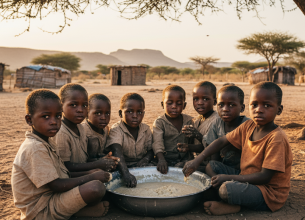
Around the world, many Muslims observe fasting during these blessed months, but in some regions, particularly in Africa and Asia, millions break their fast with very limited provisions. Offering warm meals for iftar in such places brings great spiritual rewards and the heartfelt prayers of those in need.
The Prophet (sav) said: “Seek forgiveness often in the month of Rajab. For every moment in this month, Allah has servants He frees from Hellfire. Indeed, there are mansions in Paradise reserved for those who fast during Rajab.”
(Daylami, Musnad al-Firdaus)
The Prophet (sav) said: “When it is the 15th night of Sha’ban (Barat Night), spend its night in worship and fast during its day.”
(Sunan Ibn Majah)
The Prophet (sav) said: “When Ramadan begins, the gates of mercy are opened, the gates of Hell are closed, and the devils are chained.”
(Sunan al-Nasa’i)
The Prophet (sav) said: “The best charity is that which is given in Ramadan.”
(Munawi, Fayd al-Qadir)